 gaming-horse.com
Video games are, by definition, unrealistic. Characters can jump while in midair for extra height, recover from grievous...
Why Was The Meta Quest Pro Discontinued?
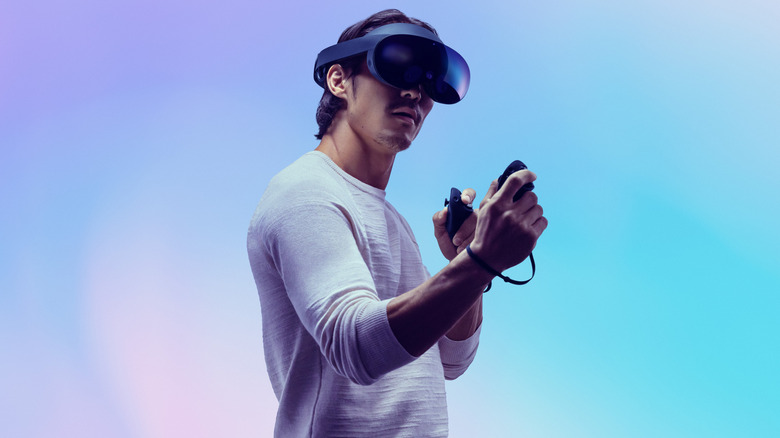
The Meta Quest Pro was supposed to be Meta’s foray into the higher-end of the VR market. A cutting-edge tech-packed piece of hardware that would provide true enthusiasts with a glimpse of what was to come from the company behind the Metaverse.
It was supposed to be more powerful, comfortable, and realistic than its predecessors. You could play more demanding games, work in a virtual office, and interact with your friends via realistic eye and face tracking. Even the controllers were powerful tools in their own right, with dedicated processors and built-in cameras to allow inside-out tracking.
But the Quest Pro didn’t perform as Meta had planned. Despite only launching in October 2022, the high-end device was discontinued by early 2025. Even a price drop from $1,499 to $999 in 2023 couldn’t turn things around and save the experimental headset. So what went wrong? Has Meta abandoned the high-end of the VR market altogether? And why did the company kill what should have been their most powerful device in the first place?
Meta really focused on the wrong things

The Quest Pro’s launch coincided with Zuckerberg’s initial “Metaverse” push. The tech billionaire didn’t just want people putting on a VR headset to fight zombies or slice up blocks with lightsabers. He wanted his customers to wear their headsets for absolutely everything. The Metaverse involved people working in VR, socializing in VR, and escaping the dingy shipping containers they live in by pretending the VR palace they’d paid actual money for was real. It was all very “Ready Player One.”
What Meta didn’t understand was that, while VR is a great platform, people did want to spend a significant amount of time in actual reality. In Facebook’s defense, the coronavirus pandemic was in full swing and remote work had become established. There was every chance that Meta could bridge the gap and become a middle ground between real-life offices and a laptop in the living room. So, the headset was more geared towards work and socialization than it was gaming.
The Meta Quest Pro just wasn’t that good
If you’re working all day in a VR headset of some kind, it needs to tick a few boxes. The resolution has to be very high and has to be extremely comfortable. While the Quest Pro managed to tick the resolution box, it really fell behind in the comfort department. Despite being shaped and padded in a comfortable-looking way, extended use would see it create hot spots on your forehead and cause pains at the back as the tightened halo dug into your skull.
Then there are the controllers, which are great in theory. Each contained three cameras and its own processor, so each controller could perform inside-out tracking like the headset. Unfortunately, this also meant the controllers needed consistently good lighting to track properly. From personal experience, I can say the tracking was never quite right on the high-end controllers. Some updates did improve it a little, but then later updates made the whole thing worse again. Using the Quest Pro likely made the Quest 3’s controllers seem even better, as I believe they were far more accurate despite the lower-tech approach.
As for content, developers have finite resources and tend to produce stuff for the most popular platform. The “Pro” sold poorly, the Quest 2 sold exceptionally well, and games produced for the Quest 2 would work on the Pro anyway. So even the extra hardware oomph wasn’t all that useful.
A key feature was missing
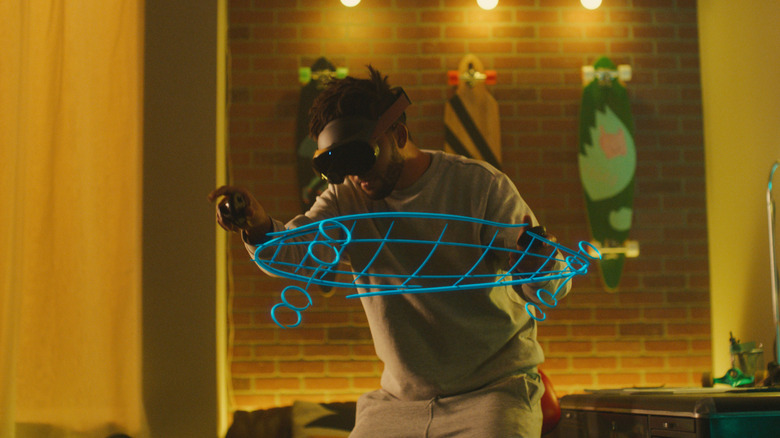
The addition of a depth sensor took the Quest 3 to another level. Basic things like boundary setting were made a lot simpler as the headset could scan walls, furniture, and potential hazards before proposing an ideal playing space. Mixed reality also got a boost, and your living room could become part of the virtual world. The Quest Pro was originally supposed to have a depth sensor, but this was ditched shortly before the headset went into production.
There were rumors the feature was spiked because of an exploit that allowed nefarious characters to “see through clothing,” but officially, it was cut due to the additional cost and weight involved in implementing it. So the cutting-edge, very expensive headset was essentially spiking high-end and standout features to keep costs down.
Other major features were just polished versions of what we saw on Quest 2. The best example of this is the “full-color passthrough,” which was just a colorized version of the greyscale passthrough we saw on the far cheaper headset. This included the same distortions, low resolution, and general misery the previous version had — but now it was in a very off, slightly trippy color.
Face and eye tracking were nice features on paper, but the social side of the Metaverse was pretty useless. Most apps didn’t, and still don’t, support the tools — so you couldn’t even use them if you wanted to. Few people had a Quest Pro, so if you enabled face and eye tracking, you’d likely be the only person at the table displaying facial expressions.
The price was a problem
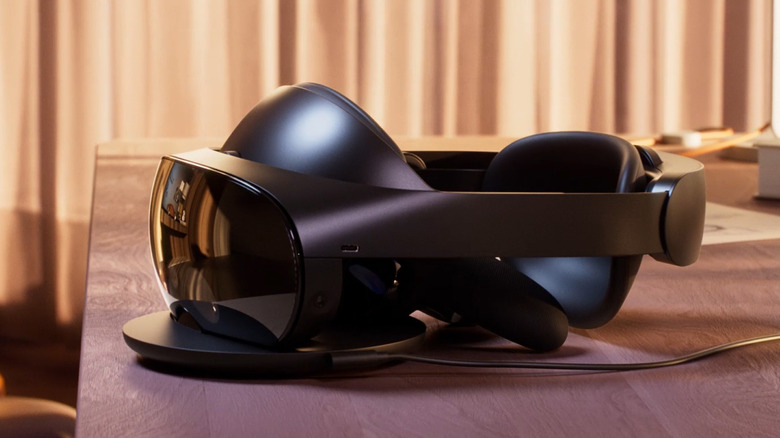
As Apple would learn a little later, proper pricing is paramount to VR success. Meta had previously brought VR to the masses with the original Quest and Quest 2. Both headsets were of good quality, easy to use, and most importantly — cheap. This allows people who would otherwise be shut out of VR by the expensive, niche, headsets that came before to experience the platform. The Quest Pro wasn’t like this; it was marketed as a high-end, tech-packed headset with a price to match. The trouble is, nothing quite adds up.
While the exact margins involved aren’t something Meta openly talks about, it’s long been accepted that the Quest 2 wasn’t a money maker. In a best-case scenario, the world’s most popular VR headset was essentially sold at cost and Meta basically broke even with it. At worst, it was a genuine loss leader, and the tech company lost a notable amount on every sale. Either way, Meta’s initial strategy wasn’t to make money through hardware. It wanted to get that hardware into as many people’s hands as possible, no matter how the bottom line looked.
The real money was in the “Metaverse.” Get everyone using your tech and basically living in it. Then, you get a small slice of every transaction in the virtual world you’ve created. If it panned out as planned, it would have been one of the greatest decisions in tech history. Unfortunately, shareholders need to be satiated and Meta’s VR arm was absolutely tanking money. The pricing makes the Pro look like an awful deal, especially compared to what came shortly after.
The Quest 3 exists
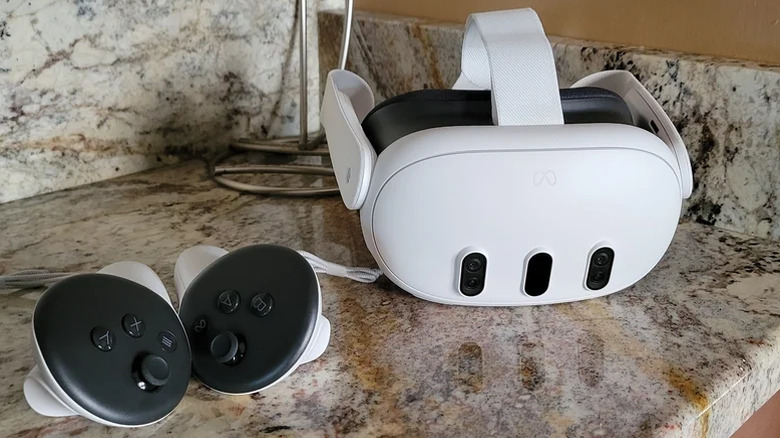
At the time of writing, the Meta Quest 3 is probably the best VR headset on the market. It beats the Pro in several key departments: Offering higher resolution, depth sensor, and better quality passthrough. The controllers also seem to track more accurately in my experience, despite lacking the inside-out tracking seen on the Pro controllers. It also has a more powerful chipset than the Pro. The Quest 3’s Snapdragon XR2+ Gen 2 offers, amongst other things, 2.5x better GPU performance than the Quest Pro’s Snapdragon XR2+ Gen 1.
To cap it all off, the Quest 3 is noticeably cheaper than the Pro, coming in at a third of the Pro’s launch price. The Pro was initially $1,500, while the Quest’s latest flagship starts at just $499. Meta also offers an even cheaper option with the Quest 3S — and while that is basically a suped-up Quest 2, it’s still a more sensible pick than the Pro.
So, while Meta got so much wrong with the Pro, what ultimately killed it was the launch of a far better, far cheaper headset. Meta hasn’t written off the Pro line, and if it’s done properly, there are enthusiasts that will splash out on cutting-edge tech. But more than anything, Meta needs to learn from its mistakes and actually produce something that justifies a high-end price tag.
Source: http://www.slashgear.com/1789980/why-meta-quest-pro-discontinued-reason-explained/
You may also like

